John Joseph Feb 09

J E Joseph

BA MA PhD FRSA

Professor of Applied Linguistics

Head of Linguistics & English Language

The University of Edinburgh

Co-editor of Language & Communication

Associate Editor of Historiographia Linguistica

Contents                  

Contact Information and Office Hours

Courses Taught 2012-13
Posts Held
Current Research Projects
Publications 2001-present (and link to earlier publications)
Papers Presented 2008-2013 and Upcoming


SaussureNews

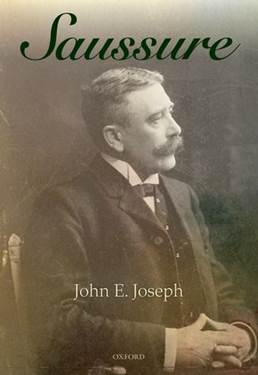
Saussure (Oxford & New York: Oxford University Press, 2012). Pp. xii + 781. ISBN: 978-0-199-69565-2. £30, $55 (hbk).

My book on the life and work of Ferdinand de Saussure is available for £27.53 from Amazon.co.uk, for $45.99 from Amazon.com. (£20.65 and $31.21 for the Kindle version.) The book was made possible by a Major Research Fellowship awarded by the Leverhulme Trust.


It is currently featured on New Books in Language, with an interview conducted by Dr George Walkden of the University of Manchester. (Also on New Books in Biography.)


HIGHLY RECOMMENDED by Choice (American Libraries Association), December 2012.


“This is a vastly ambitious biography which leaves nothing aside. It is neither debunking or hagiography. A major piece of scholarship.” — Jonathan Culler, Cornell University


Excerpts from reviews:

“John E. Joseph’s monumental Saussure … sheds brilliant light on his life and work. This rich account — sympathetic, respectful and sensitive to political and intellectual context — reveals how Saussure, a dazzling and driven scholar from a bourgeois Swiss family, blazed trails to new vistas of social science that opened out in the century after his death.” — John A. Goldsmith, Nature

“John E. Joseph does the work of both a linguist and a historian. He gives us all the historical elements needed to understand Saussure’s background … and paints a very vivid portrait of the political tensions of his time and their repercussions on the university world, which Saussure had to endure … On the linguistic plane, John E. Joseph spares no effort in helping readers grasp what was at stake in Saussure’s reflections. He allows us to understand better what Saussure did that was revolutionary…” — Claire A. Forel, Le Temps

“An epic biography of the inventor of modern linguistics. Joseph presents a detailed scholarly account which is both readable and entertaining.” — The Biographers’ Club

“Joseph’s massive, meticulous book is a heroic biography, tightly focused on its protagonist and with a melodramatic, if not tragic, tone of knowing retrospection. Joseph lays out the many crushing psychological, familial, social, institutional and professional forces arrayed against his brilliant, headstrong subject… There is a growing sense of inevitability as Joseph’s story unfolds… Joseph gives us all the particulars that can be had from the archive, more than one imagined could be so carefully documented.” — Michael Silverstein, London Review of Books

“John Joseph has made excellent use of the manuscripts preserved in the Geneva library.” — Roy Harris, TLS

“A monumental work that bears witness to meticulously detailed research and to an encyclopaedic knowledge that it would be hard to surpass. For anyone seeking information on the life of Ferdinand de Saussure and the genesis of his writings and his aborted projects, Joseph’s Saussure constitutes a practically inexhaustible treasury.” — Peter Wunderli, Historiographia Linguistica

“Joseph provides a confident and detailed analysis of Saussure’s theories and arguments, identifying and explaining those elements that were perceived as brilliant at the time, those that endured, and those that did not. […T]he book cannot but become the definitive volume on Saussure’s life and an essential reference in further debate on his intellectual contribution. Many of the questions that have been debated for years are re-examined in this volume in the context of documentary evidence that is not only new to the discussion, but demands to be taken into account.” — Penny Lee, Australian Journal of Linguistics

“It’s a cracking read and I thoroughly enjoyed it.” — Paul O’Doherty, Bookbound, Dublin City Radio

“The present work … is now the biography of Saussure. There is, quite simply, no other work today in English that has the breadth and range of this one in laying out the personal details of Saussure’s life, while at the same time covering the depth of his intellectual and academic output … and strivings, conflicts, and accomplishments… This is a substantive and erudite overview, analysis, and assessment of the life and work of this seminal linguist. Summing Up: HIGHLY RECOMMENDED.” — D. B. Boersema, Choice

“Saussure was idolized by structuralists in the 1960s. His Course in General Linguistics was on the nightstand of students of anthropology, literary theory, psychoanalysis and, of course, linguistics. But who was he, and what did he actually achieve? This book of more than 700 pages undertakes to answer these two questions — with success.” —  Books: Livres et idées du monde entier

“John Joseph is an eminent figure in the constellation of Saussurean studies. He is distinguished by the attention he devotes to establishing biographical facts, often neglected by other researchers who confine themselves to epistemological and philosophical exegesis… With this book, readers have access to a mass of personal information of unequalled comprehensiveness and quality… The challenge of undertaking in parallel a factual biography and the scientific analysis of the texts is conquered with brio.” — Gabriel Bergougnioux, Bulletin de la Société de Linguistique de Paris

“Monumental.” — Daniele Gambarara, Il Manifesto

“Variously portrayed as an austere Calvinist intellectual or a half-mad romantic, Saussure the man has remained an enigma. John E Joseph’s well-researched biography finally gives us the full picture; what emerges is a character of multiple contradictions, a profound thinker who struggled throughout his life to define both himself and his ideas… John E Joseph’s biography is a rich, scholarly account, exhaustively detailed, pursuing the Saussure family back into the fifteenth century and forward to the present day. Every twist and turn of Saussure’s intellectual trajectory is mapped out and analysed.” — Patrick Wilcken, Literary Review

“John E. Joseph restores Saussure’s voice to life, and reveals the waves of development of his thought, while situating him fascinatingly in the wider history of linguistics.” — Julie Bouchard, La Recherche: L’Actualité des Sciences

“One of the many things that one learns from Joseph’s mammoth study is that Saussure developed many of his central insights early and that his teachers still relied on the pre-comparativist, ‘Port Royal’ conceptions of language that encouraged the understanding of language as a system — conceptions Saussure never abandoned. The book is at its most fascinating as it traces Saussure’s engagement first with the neo-grammarians and then with the French school of linguistics, of which he became the unofficial doyen even after he abandoned teaching at the École pratique des hautes études in Paris for his beloved Geneva.” — Colin MacCabe, New Statesman

·       Recently appeared articles:

“Alien Species: The Discursive Othering of Grey Squirrels, Glasgow Gaelic, Shetland Scots and the Gay Guys in the Shag Pad”. Language and Intercultural Communication 13/2 (2013), 182-201.

“Identity Work and Face Work across Linguistic and Cultural Boundaries”. Journal of Politeness Research 9 (2013), 35-54.

“Pour une réévaluation des frontières nationales dans la linguistique des années 1930-60” (Re-evaluating national borders in linguistics, 1930s-60s). Les dossiers de HEL (Histoire–Épistémologie–Langage), Paris, Société de l’Histoire et de l’Épistémologie des Sciences du Langage, n° 3 (2013), http://htl.linguist.univ-paris-diderot.fr/num3/num3.htm

Review of Zellig Harris: From American Linguistics to Socialist Zionism, by Robert F. Barsky, The European Legacy (2013), DOI: 10.1080/ 10848770.2013.791442 [published electronically 14 May 2013, hard copy to follow.]

“‘All Languages Are Equally Complex’: The Rise and Fall of a Consensus”, by John E. Joseph & Frederick J. Newmeyer. Historiographia Linguistica 39 (2012), 341-368.

“Language Pedagogy and Political-Cognitive Autonomy in Mid-19th Century Geneva: The Latin Manuals of Louis Longchamp (1802-1874)”. Historiographia Linguistica 39 (2012), 259-277.

“La voie radicale de la linguistique appliquée à Édimbourg” (The Radical Road of Edinburgh Applied Linguistics). Les dossiers de HEL (Histoire–Épistémologie–Langage), Paris, Société de l’Histoire et de l’Épistémologie des Sciences du Langage, n° 5 (2012), http://htl.linguist.univ-paris-diderot.fr/num5/num5.html

“Small Universes and Big Individuals: Locating Humboldt in Evolving Conceptions of Language and Individualität”. Wilhelm von Humboldt: Universalität und Individualität, ed. by Ute Tintemann & Jürgen Trabant, 95-111. Munich: Wilhelm Fink, 2012.

“The Genius of the Italian Language: Politics and Poetics”, review article on Irresistible Signs: The Genius of Language and Italian Nationalism, by Paola Gambarota. Historiographia Linguistica 39 (2012), 369-377.


Contact Information and Office Hours

Mailing address: Linguistics & English Language, The University of Edinburgh, Dugald Stewart Building, 3 Charles Street, Edinburgh EH8 9AD, UK.

E-mail address: John.Joseph@ed.ac.uk

Office phone: +44 (0)131 650 3497 / Secretary’s phone: +44 (0)131 650 6802

Fax: +44 (0)131 651 3190

Office: 2.08 Dugald Stewart Building

Office hour: by appointment


Courses Taught 2012-13

MSc Courses: Issues in Applied Linguistics/Language, Education and Society; Introduction to Discourse Analysis (Semester I); Applied Linguistics and Language Teaching (Semester II).


Posts Held

Professor of Applied Linguistics (since 1 January 1997) and Head of Linguistics & English Language (since 1 July 2011), The University of Edinburgh. I previously served as Head of the Department of Applied Linguistics from 1997 until 1999, when we merged to form the Department of Theoretical & Applied Linguistics. Another merger in 2005 has created Linguistics & English Language (LEL) as a subject area within the School of Philosophy, Psychology & Language Sciences (PPLS).

LEL descends principally from the Chair of English Language and General Linguistics, to which Angus McIntosh (1914-2005) was appointed in 1948, and the School of Applied Linguistics, founded by Ian Catford in 1957. In 1964 McIntosh’s chair was split, with him continuing to occupy the Chair of English Language, while a new chair of General Linguistics was created to which John Lyons was appointed. Also in 1964 a Chair of Phonetics was created for David Abercrombie (1909-1992), who had been lecturing at Edinburgh since 1948. In 1967 General Linguistics and Phonetics merged to form the Department of Linguistics & Phonetics, then were joined in 1969 by Applied Linguistics to form the Department of Linguistics. Applied Linguistics then split off in 1985 to form a separate department.

Previous posts and visiting posts. Professor of English Language and Linguistics and Head of the Department of English at the University of Hong Kong (1993-96). Associate Professor in the Department of French and Italian at the University of Maryland at College Park (1986-93). Assistant, then Associate Professor in the Department of Foreign Languages and Literatures at Oklahoma State University (1981-85).

From 1978-80 I taught French at the University of Michigan, Ann Arbor while completing my PhD there, and in 1980-81 was Lecturer in Linguistics at the Université Paul Valéry in Montpellier, France. In 1985 I was Visiting Associate Professor at the University of Maine, and in 1993 I held joint fellowships from the National Endowment for the Humanities and the Camargo Foundation in Cassis, France. In 1998 I spent a month as Visiting Research Associate in the Center for English Language Research and Teaching at the American University of Beirut, Lebanon. In 1999-2000 I held a Research Fellowship from the Leverhulme Trust for a project on identity and the construction of language. In the summers of 2000 and 2001 I taught a course on the Master’s in Applied Linguistics at RELC, the Regional Language Centre of the Southeast Asian Ministers of Education Organisation, in Singapore, and in the summers of 2003-4 I co-convened (with Talbot J. Taylor) a Summer Institute on “The Concept of Language in the Academic Disciplines” at the National Humanities Center (North Carolina) and the Wissenschaftskolleg zu Berlin.

Offices in Professional Organisations

Editorial Activities

Back to top

Current Research Projects

Language and Identity, 2nd ed. I am currently planning a new, expanded edition of Language and Identity: National, Ethnic, Religious, to be published by Palgrave Macmillan.

Language and the Body — the Abstract and the Concrete. Over the last decade, as part of my research on language and identity, language and politics and the history of linguistics, I have been been pursuing an enquiry into the bodily dimensions of language, from ancient times to the present. I am now drawing this together into a unified project, covering both conceptual developments and their (sometimes horrific) applications. It is a challenge, because so many different aspects of the subject are involved, including but not limited to:

·        the Aristotelian model of language as physical reponse to perception or judgement, mediated by pathemata and phantasia

·        how and why the Galenic tradition of treating language as a bodily phenomenon was (nearly) lost

·        the Epicurean belief in the origin of language as a manifestation of the racial body

·        the Christian disjunction between the language of beings with and without bodies

·        the shifting views from the Renaissance to the presence as to what constitutes concreteness and abstraction in language

·        how the creation of a ‘standard language’ represents an attempt to abstract language away from its bodily aspects toward a purely rational ideal

·        how modern linguistics too has tried to imagine language as purely mental, marginalising (or idealising) all its physical aspects

·        changing views and uses of obscene language, and how it can be seen as a return of the repressed body

·        how, for Saussure, all linguistic signs are abstract (in our use of the term, though ‘concrete’ in his)

·        how historical linguistics has based itself on preconceptions about the relationship of the mental and the physical

·        the place of the bodily in evolutionary and genetic approaches to language

·        the place of the bodily in the relationship between racism and linguistics

·        how the ‘social’ relates to the body

·        attempts in the 20th century to diagnose schizophrenia through the overuse of concrete terms

·        attempts at ‘lie detection’ through the measurement of physical phenomena during language production

·        the reinscribing of language in the body in French structuralism (particularly Merleau-Ponty and Bourdieu)

·        how ‘distributed cognition’ creates new possibilities for rescuing language from the dominant mental/rational idealisations

·        how recent work tracing mental processing of concrete and abstract words using fMRI scans is rendered dubious by an insufficiently critical approach to these categories.

Back to top

Publications 2001-present

(For my publications prior to 2001, and of book reviews and some minor items, click here).

Books Authored

http://ec1.images-amazon.com/images/P/074862452X.01._SS500_SCLZZZZZZZ_V64076805_.jpgLanguage and Politics. (Edinburgh Textbooks in Applied Linguistics Series.) Edinburgh: Edinburgh University Press, 2006. Pp. x, 170. ISBN: 074862452 / 0748624538 (pbk). Distributed in USA by Columbia University Press, New York.

— Latvian version, Valoda un Politika, translated by Romāra Valdmane, Riga: Zinātne Publishers, 2008. Pp. 207. ISBN: 978-9984-808-51-2.

“…the implications of Joseph’s stance can hardly be exaggerated… the veneer of science does not make linguistics any the less political; it only helps to camouflage its political nature… There can be no doubt that he has succeeded immensely in his self-confessed project of stimulating further discussion.” - Applied Linguistics

“It is a book that I found stimulating, extremely wide ranging, well argued, at times witty (a sign of assurance), always to the point, and one that admirably fulfils its aim to provide an advanced introduction to a chosen field of contemporary applied linguistics within the series of publications to which it belongs.” - ELT Journal

“…an incredibly comprehensive but detailed discussion of the subject…” - Language and Literature

“Joseph’s volume is a much needed exploration of the political aspects of language and would undoubtedly serve as a useful course text… [T]his text is invaluable in that it is able to take up the key ideas that surround issues of language and politics and includes an excellent introduction to the theories and theorists who have contributed to the debates.” - Language Policy

“In his monograph, John E. Joseph sets out to explore a variety of topics under the rubric of language and politics; and he succeeds in tying together variegated threads to provide a broad yet coherent introduction to the subject. The book, as part of the Edinburgh Textbooks in Applied Linguistics series, is aimed at a master’s level postgraduate audience. Yet the concise format and accessible presentation make it well-suited for a variety of undergraduate sociolinguistics courses as well. In fact, one of the book’s strengths is its explicit articulation of many ideas central not just to language and politics, but to the study of language in society more broadly.” - Journal of Sociolinguistics

“His discussion of Chomsky’s views on language and politics is the best I have read, and when combined with Joseph’s fair treatment of CDA methodology, Chapter 6 could stand alone as an excellent reading for an introductory course on linguistics, communication, or discourse analysis. Joseph’s book presents many strong opinions, not all of which I personally agree with. But my acts of disagreement exactly prove his point: that politics in language is always and everywhere, or at least has the potential to be. Embracing the politics in his own language, Joseph is quite frank with his own opinions and engages the reader in a provocative discussion of every controversial issue. I highly recommend this book for anyone interested in language and the people who use it.” - Discourse & Society

Language and Politics is that rare thing, a book that will function equally well as an introduction for novices and as a scholarly resource for established academics and researchers. Even though it is published in an Applied Linguistics series, it will certainly be of interest to scholars outside this discipline, such as sociologists, political scientists, social psychologists, and historians. I started this review of Language and Politics with a reference to Joseph’s previous book, Language and Identity. Together these books provide excellent and up-to-date treatments of both the historical and contemporary roles played by language in our political life, and of politics in our understanding and experience of language. It will not be surprising if both these books enjoy the privilege of second and third lives: they certainly deserve to be used widely as teaching and scholarly resources.” - Southem African Linguistics and Applied Language Studies

“In sum, an important contribution for understanding the reality of the politics of language, and the language of politics, in the world in which we live.” - DELTA: Documentação de Estudos em Lingüística Teórica e Aplicada

“Few applied linguists in the 21st century either could or would want to deny the significance of political questions for their thinking and their practice. Teachers and students of applied linguistics will therefore welcome John Joseph’s wide-ranging and informative text. In the spirit of his initial declaration that ‘language is political from top to bottom’, Joseph brings together issues that are often kept apart, draws on insights from a range of disciplines and thinkers, and offers - while explicitly inviting the reader to argue or disagree with him - his own perspectives on such topical questions as linguistic imperialism and the global spread of English, hate speech and politically correct language, and the ‘manufacture of consent’ through political propaganda. The result is a grown-up introductory text, addressed to readers who want their textbooks to make them think.” - Deborah Cameron, Rupert Murdoch Professor of Language and Communication, University of Oxford

Language, this book argues, is political from top to bottom, whether considered at the level of an individual speaker’s choice of language or style of discourse with others (where interpersonal politics are performed), or at the level of political rhetoric, or indeed all the way up to the formation of national languages. By bringing together this set of topics and highlighting how they are interrelated, the book will function well as a textbook on any applied or sociolinguistic course in which some or all of these various aspects of the politics of language are covered.

CONTENTS

Chapter One: Overview: How politics permeates language (and vice-versa)  [draft.doc]

Chapter Two: The social politics of language choice and linguistic correctness

Chapter Three: Politics embedded in language

Chapter Four: Taboo language and its restriction

Chapter Five: Rhetoric, propaganda and interpretation

Chapter Six: Conclusion: Power, hegemony and choices

Order from Edinburgh University Press      Order from Columbia University Press


lg & identity coverLanguage and Identity: National, Ethnic, Religious. Houndmills, Basingstoke, Hampshire & New York: Palgrave Macmillan, 2004. Pp. xii, 268. ISBN: 0333997522 / 0333997530 (pbk).

— Arabic version, al-Lugha wa al-Huiya, translated by Abdel Nour Kraci, Kuwait: National Council for Culture, Arts & Letters, 2007. Pp. 344. (For more information see http://www.annabaa.org/nbanews/66/507.htm.)

“…the best overarching treatment of this topic to appear in recent years … I would recommend this book very highly to all those with an interest in contemporary linguistics. The author’s achievement in this volume is considerable, as the sweep of his discussion unpacks a wide range of previously compartmentalized discussions of identity and language. The major strength of the book is that it operates at the level of ideas, not only from linguistics and psychology, but also ideas at a level of intellectual discussion that cuts across the humanities and social sciences.” - International Journal of Applied Linguistics

“…one of the most illuminating and enjoyable scholarly works I have read on the subject. What makes Joseph’s book all the more admirable is the author’s ability to make complex theories of language and identity appear deceitfully simple without dumbing them down…. Language and Identity is a most welcome contribution to scholarship on the language-identity nexus. It is a compelling read that should figure on the reading list of any course on language and identity.” - International Journal of Bilingual Education and Bilingualism

“This book is a profound introduction to a complex topic, yet eminently enjoyable and thus a very welcome addition to the field.” - The Year’s Work in English Studies

Language and Identity is an unsentimental, accurate, timely and useful book. It tells linguists to take sociology and politics more seriously, and the rest of us to get our linguistics right.” - Journal of Multilingual and Multicultural Development

“…Language and Identity offers an enlightening synopsis of the research on language and identity across diverse disciplines. The case studies provide invaluable access to the role of language in the nation-states of Hong Kong and Lebanon through ethnographic research. I recommend this book for readers within or outside academia who seek an overview of the intimate connection between language and identity from theoretical as well as empirical perspectives. The combination of these two perspectives makes this book an excellent introduction to the study of language and identity for both teaching and research.” - Journal of Sociolinguistics

“This book opens an interesting and well-founded window on how language and ethnic, religious and national identity interconnect and give rise to the individual’s social self-image, and to the group’s image in the eyes of its members. It is about finding the human aspect, recovering the history of culture and social functioning, which is not merely mechanical, but takes account of the ideas, beliefs and illusions that are the baggage we carry with us on our journey.” - Language Problems and Language Planning

“Joseph’s reader-friendly book will also make a great primary text for advanced undergraduate and graduate classes dealing with language, society, and identity…” - Estudios de Sociolingüística

“...admirable both in its scope and in its depth - the book goes far beyond prior books touching on language and identity... It is well-written and should make for trouble free (and even enjoyable) reading by undergraduates, graduate students and the educated lay reader interested in language and languages or in the related social sciences, psychology and, perhaps, even literary studies.” - Joshua A. Fishman, Distinguished University Professor, Yeshiva University, USA

Offering a uniquely broad-based overview of the role of language choice in the construction of national, ethnic and religious identity, this textbook examines a wide range of specific cases from various parts of the world in order to arrive at some general principles concerning the links between language and identity. It will benefit students and researchers in a wide range of fields where identity is an important issue and who currently lack a single source to turn to for an overview of sociolinguistics.

CONTENTS
Chapter One: Introduction
Chapter Two: Linguistic Identity and the Functions and Evolution of Language
Chapter Three: Approaching Identity in Traditional Linguistic Analysis
Chapter Four: Integrating Perspectives from Adjacent Disciplines
Chapter Five: Language in National Identities
Chapter Six: Case Study 1 -The New Quasi-Nation of Hong Kong
Chapter Seven: Language in Ethnic/Racial and Religious/Sectarian Identities
Chapter Eight: Case Study 2 - Christian and Muslim Identities in Lebanon
Afterword: Identity and the Study of Language

Read a sample chapter and Order from Palgrave Macmillan (UK)    Order from Palgrave Macmillan (USA)  


whitney chomsky coverFrom Whitney to Chomsky: Essays in the History of American Linguistics. (Studies in the History of the Language Sciences Series, 103.) Amsterdam and Philadelphia: John Benjamins, 2002. Pp. viii, 234. ISBN: 1588113493 / 1588113507 (pbk).

“Any reader comes away from J[oseph]’s volume with a strong sense of the urgency for linguistics in particular to pay much closer attention to the specifics of its own history and no less to the place of that history in the culture from which it emerges.” - Language

“[...] broad in scope, eclectic in coverage, and highly original in its insights about a history that has alays been far too simple, self-contained, and sanitized to be the whole story.” - Journal of the History of the Behavioural Sciences

What is ‘American’ about American linguistics? Is Jakobson, who spent half his life in America, part of it? What became of Whitney’s genuinely American conception of language as a democracy? And how did developments in 20th-century American linguistics relate to broader cultural trends? This book brings together 15 years of research by John E. Joseph, including his discovery of the meeting between Whitney and Saussure, his ground-breaking work on the origins of the ‘Sapir-Whorf Hypothesis’ and of American sociolinguistics, and his seminal examination of Bloomfield and Chomsky as readers of Saussure. Among the original findings and arguments contained herein:
-- why ‘American structuralism’ does not end with Chomsky, but begins with him;
-- how Bloomfield managed to read Saussure as a behaviourist avant la lettre;
-- why in the long run Skinner has emerged victorious over Chomsky;
-- how Whorf was directly influenced by the mystical writings of Madame Blavatsky;
-- how the Whitney-Max Müller debates in the 19th century connect to the intellectual disparity between Chomsky’s linguistic and political writings.

Order From Whitney to Chomsky from John Benjamins Publishing Company


landmarks coverLandmarks in Linguistic Thought II: The Western Tradition in the Twentieth Century (with Nigel Love and Talbot J. Taylor). (Routledge History of Linguistic Thought Series.) London and New York: Routledge, 2001. Pp. xiii, 265. ISBN: 0415063965 / 0415063973 (pbk).

“…Landmarks in linguistic thought II is an excellent, immensely useful book, which all students of language ought to be encouraged to read and discuss. It is well written, intelligently conceived and very accessible. I would very much have liked to have had access to it when I was an undergraduate student.” - Journal of Linguistics

“...fills a long-standing need for an intellectually solid survey of thought about language that bridges the divide between language philosophy and linguistics.... Should be required reading in virtually any academic course, graduate or undergraduate, that deals to any extent with language.” - Paul Hopper, Carnegie Mellon University

Landmarks in Linguistic Thought II introduces the major issues and themes that have determined the development of Western thinking about language, meaning and communication in the twentieth century. Each chapter contains an extract from a ‘landmark’ text followed by a commentary, which places the ideas in their social and intellectual context. The book is written in an accessible and non-technical manner and summarizes the contribution of the key thinkers who have shaped modern linguistics: Austin, Bruner, Chomsky, Derrida, Firth, Goffman, Harris, Jakobson, Labov, Orwell, Sapir, Skinner, Whorf, Wittgenstein. This second volume follows on from Landmarks in Linguistic Thought I, which introduces the key thinkers up to the twentieth century. The series is ideal for anyone with an interest in the history of linguistics or of ideas.

Order Landmarks II from Amazon.co.uk
Order Landmarks II from Amazon.com

http://ecx.images-amazon.com/images/I/41CQZBCDP1L._AA240_.jpg

And one pre-2001 item:

Limiting the Arbitrary: Linguistic Naturalism and its Opposites in Plato’s Cratylus and Modern Theories of Language. (Studies in the History of the Language Sciences Series, 96.) Amsterdam and Philadelphia: John Benjamins, 2000. Pp. ix, 224. ISBN: 1556197497.

“[A] must-read for any serious linguist, let alone a linguistic historiographer. [The author’s] mission is to challenge linguists to reflect on their own fundamental assumptions and to recognize that there is nothing much new under the sun — and in this he succeeds admirably. The whole is an enjoyable and thought-provoking read.” - Historiographia Linguistica

The idea that some aspects of language are ‘natural’, while others are arbitrary, artificial or derived, runs all through modern linguistics, from Chomsky’s GB theory and Minimalist program and his concept of E- and I-language, to Greenberg’s search for linguistic universals, Pinker’s views on regular and irregular morphology and the brain, and the markedness-based constraints of Optimality Theory. Limiting the Arbitrary traces the heritage of this linguistic naturalism back to its locus classicus, Plato’s dialogue Cratylus. Part One is a detailed examination of the linguistic arguments in the Cratylus. Part Two follows three of the dialogue’s naturalistic themes through subsequent linguistic history -- natural grammar and conventional words, from Aristotle to Pinker; natural dialect and artificial language, from Varro to Chomsky; and invisible hierarchies, from Jakobson to Optimality Theory -- in search of a way forward beyond these seductive yet spurious and limiting dichotomies.

Order Limiting the Arbitrary from John Benjamins Publishing Company


Books Edited

·       Language and Politics: Major Themes in English Studies, 4-volume set, ed. with a new introduction by John E. Joseph. London and New York: Routledge, 2010. Pp. xlviii + 1,550. ISBN: 978-0-415-45243-4.

VOLUME ONE — The Language of Politics I (pp. xxii + 272, individual volume ISBN 978-0-415-45244-1)

Introduction: John E. Joseph. PART 1 Persuasion and propaganda — The theory of political propaganda: Harold D. Lasswell; Propaganda analysis: Hadley Cantril; Propaganda and demotic speech: George Orwell; Progressive propaganda critics and the magic bullet myth: J. Michael Sproule; Language in the service of propaganda: Noam Chomsky. PART 2 Language and political theory — Of power: John Locke; Excerpt from The Limits of Jurisprudence Defined: Jeremy Bentham; Review of The Language of Politics by Boulton: Raymond Williams; Political theory & the language of politics: Nicholas Xenos; Locke on language in (civil) society: Hannah Dawson. PART 3 Political uses of language in the past — Excerpts from Remarks on the Use and Abuse of Some Political Terms: Sir George Cornewall Lewis; Review of Use and Abuse of Political Terms by Lewis: John Stuart Mill; American political cant: Lowry Charles Wimberly; Excerpts from LTI (The language of the Third Reich): Victor Klemperer; Excerpts from The tyranny of words: Stuart Chase.

VOLUME TWO — The Language of Politics II (pp. ix + 511, individual volume ISBN 978-0-415-45245-8)

PART 4 Political uses of language in recent decades — Antitotalitarian language in Poland: some mechanisms of linguistic self-defense: Anna Wierzbicka; Images of involvement and integrity: rhetorical style of a Japanese politician: Senko K. Maynard; The making of the language of New Labour, Norman Fairclough; Metaphors of dictatorship and democracy: change in the Russian political lexicon and the transformation of Russian politics: Richard D. Anderson, Jr.; New liberal speak: notes on the new planetary vulgate: Pierre Bourdieu & Loïc Wacquant; Grammar - the first covert operation of war: David G. Butt, Annabelle Lukin & Christian M. I. M. Matthiessen; Bush’s and Gore’s language and gestures in the 2000 US presidential debates: a test case for two models of metaphors: Alan Cienki. PART 5 Analysing political language — Conservative words and radical sentences in the semantics of international politics: Charles E. Osgood; Official discourse and state apparatuses: F. Burton & P. Carlen; Rules and regulations: Roger Fowler & Gunther Kress; Language and politics: indirectness in political discourse: Samuel Gyasi Obeng; Being politically impolite: extending politeness theory to adversarial political discourse: Sandra Harris; Discourse and metadiscourse in parliamentary debates: Cornelia Ilie;  The institutional provision for silence: on the evasive nature of politicians’ answers to reporters’ questions: Kevin McKenzie; ‘I’ll tell you what the truth is’: the interactional organization of confiding in political interviews: Anita Fetzer & Marjut Johansson. PART 6 Ideology in political discourse — Undemocratic discourse: a review of theory and research on political discourse: John Gastil; The intersection of economic signals and mythic symbols: Cyril Morong; Political discourse and ideology: Teun A. Van Dijk; Preempting the future: rhetoric and ideology of the future in political discourse: Patricia L. Dunmire.

VOLUME THREE — The Politics of Language I (pp. viii + 367, individual volume ISBN 978-0-415-45246-5)

PART 7 Marxist views on language — Excerpts from Marxism and the philosophy of language: V. N. Voloshinov; Notes on language: Antonio Gramsci; Concerning Marxism in linguistics: Joseph Stalin; Marr, Stalin and the theory of language: M. Miller; The recent conflict in Soviet linguistics: Herbert Rubenstein; Language, agency and hegemony: a Gramscian response to post-Marxism: Peter Ives; Ideology and post-Marxism: Ernesto Laclau. PART 8 Performativity and identity — Intermediate reflections: social action, purposive activity, and communication: Jürgen Habermas; The politics of recognition: Charles Taylor; Speech acts and unspeakable acts: Rae Langton; Sovereign performatives in the contemporary scene of utterance: Judith Butler. PART 9 Language and the structure of society — The order of discourse: Michel Foucault; The forms of capital: Pierre Bourdieu; Elite discourse and the reproduction of racism: Teun A. Van Dijk; Minority nationalism and immigrant integration: Will Kymlicka.

VOLUME FOUR — The Politics of Language II (pp. ix + 400, individual volume ISBN 978-0-415-45247-2)

PART 10 Language choice and language policy — Language choice and cultural imperialism: a Nigerian perspective: Joseph Bisong; Of EFL teachers, conscience, and cowardice: Kanavillil Rajagopalan; On EFL teachers, awareness, and agency: A. Suresh Canagarajah; Reply to Canagarajah: Kanavillil Rajagopalan;  Uncommon languages: the challenges and possibilities of minority language rights: Stephen May; African mother-tongue programmes and the politics of language: linguistic citizenship versus linguistic human rights: Christopher Stroud; Liberal neutrality and language policy: Alan Patten; ‘Global English’: linguistic imperialism or practical lingua franca?: Peter Ives. PART 11 Politics in language — Politics and the English language: George Orwell; The pronouns of power and solidarity: Roger Brown & Albert Gilman; Language, politics, and composition: a conversation with Noam Chomsky: Gary A. Olson & Lester Faigley; Troubling clarity: the politics of accessible language: Patti Lather; The neutrality of the status quo: Robin T. Lakoff. PART 12 ‘Critical’ (applied) linguistics and critical discourse analysis — Notes on critical linguistics: Roger Fowler; Against arbitrariness: the social production of the sign as a foundational issue in critical discourse analysis: Gunther Kress; Teaching the politics of Standard English: Anne Curzan; ‘Political correctness’: the politics of culture and language: Norman Fairclough; Emotion and language politics: the Brazilian case: Kanavillil Rajagopalan; Disinventing and (re)constituting languages: Sinfree Makoni & Alastair Pennycook.

Forthcoming:

Ferdinand de Saussure: Critical Assessment of Leading Linguists, 4-volume set, ed. with a new introduction by John E. Joseph. London and New York: Routledge, publication date 4 September 2013. ISBN: 978-0-415-46546-5.


Chapters in Books

“Small Universes and Big Individuals: Locating Humboldt in Evolving Conceptions of Language and Individualität”. Wilhelm von Humboldt: Individualität und Universalität, ed. by Ute Tintemann & Jürgen Trabant, 95-111. Munich: Wilhelm Fink, 2012.

Chomsky's Atavistic Revolution (with a little help from his enemies)”. Chomskyan (R)evolutions, ed. by Douglas A. Kibbee, 1-18. Amsterdam and Philadelphia: John Benjamins, 2010.

“Communicating Hatred: Language, Identity and the Crime of Incitement”. Linguistic Interaction in/& Specific Discourses, ed. by Marta Conejero López, Micaela Muñoz Calvo & Beatriz Penas Ibáñez, 65-78. València: Universitat Politècnica de València, 2010.

“Hermeneiaphobia: Why an ‘Inventive’ Linguistics Must First Embrace Interpretation”. Inventive Linguistics, ed. by Sandrine Sorlin, 95-105. Montpellier: Presses Universitaires de la Méditerranée, 2010.

“Identity”. Language and Identities, ed. by Carmen Llamas and Dominic Watt, 9-17. Edinburgh: Edinburgh University Press, 2010.

“Language and Nationalism.” Nations and Nationalisms: A Global Historical Overview, ed. by Guntram H. Herb and David H. Kaplan, vol. 2: 1880-1945, 471-484. Santa Barbara, Denver and Oxford: ABC-CLIO, 2008.

“842, 1871 and All That: Alsace-Lorraine and the Transformations of Linguistic Nationalism”. The French Language and Questions of Identity, ed. by Wendy Ayres-Bennett and Mari C. Jones, 44-52. London & Cambridge, Mass.: Legenda, 2007.

“Il comportamento linguistico di un gruppo minoritario”. Minoranze linguistiche: Prospettive, strumenti, territori, a cura di Carlo Consani e Paola Desideri, 48-55. Roma: Carocci, 2007.

“The Natural: Its Meanings and Functions in the History of Linguistic Thought”. Papers from the Tenth International Conference on the History of the Language Sciences (ICHoLS X), University of Illinois at Urbana-Champaign, 2-5 Sep. 2005, ed. by Douglas A. Kibbee, 1-23. (Studies in the History of the Language Sciences.) Amsterdam & Philadelphia: John Benjamins, 2007.

“‘The Grammatical Being Called a Nation’: History and the Construction of Political and Linguistic Nationalism”. Language and History: Integrationist Perspectives, ed. by Nigel Love, 120-141. (Routledge Advances in Communication and Linguistic Theory, 4.) London & New York: Routledge, 2006.

“The Shifting Role of Languages in Lebanese Christian and Moslem Identities”. Explorations in the Sociology of Language and Religion, ed. by Joshua A. Fishman and Tope Omoniyi, 165-179. Amsterdam and Philadelphia: John Benjamins, 2006.

“The Tongues of Men and of Angels: Knowledge, Inner Speech and Diglossia in Medieval Linguistic Thought”. Flores Grammaticae: Essays in Memory of Vivien Law, ed. by Nicola McLelland and Andrew R. Linn, 119-139. (The Henry Sweet Society Studies in the History of Linguistics, 10.) Münster: Nodus, 2005.

“Les affinités psychologiques de Victor Henry”. Linguistique et partages disciplinaires à la charnière des XIXe et XXe siècles: Victor Henry (1850-1907), ed. by Christian Puech., 291-307. (Bibliothèque de L’Information Grammaticale, 55.) Louvain & Paris: Peeters, 2004.

“Body, Passions and Race in Classical Theories of Language and Emotion”. Emotion in Dialogic Interaction: Advances in the Complex, ed. by Edda Weigand, 73-96. (Current Issues in Linguistic Theory, 248.) Amsterdam & Philadelphia: John Benjamins, 2004.

“Créativité linguistique, interprétation et contrôle de l’esprit selon Orwell et Chomsky”. Le discours sur la langue sous les régimes autoritaires, ed. by Patrick Sériot and Andrée Tabouret-Keller, 81-92. Lausanne: Cahiers de L’Institut de Linguistique et des Sciences du Langage de l’Université de Lausanne, no. 17, 2004. Reprinted in *Texto!*, vol. 11, no. 2 (juin 2006), available on:

http://www.revue-texto.net/Inedits/Joseph_Creativite.html.

“Language and Politics”. The Handbook of Applied Linguistics, ed. by Alan Davies and Catherine Elder, 347-366. (Blackwell Handbooks in Linguistics.) Malden, Mass. and Oxford: Blackwell, 2004.

“Linguistic Identity and the Limits of Global English”. Globalization: English and Language Change in Europe, ed. by Anna Duszak and Urszula Okulska, 17-33. Frankfurt, Berlin, Bern, Brussels, New York & Oxford: Peter Lang, 2004.

“The Linguistic Sign”. The Cambridge Companion to Saussure, ed. by Carol Sanders, 59-75. Cambridge: Cambridge University Press, 2004.

“Rethinking Linguistic Creativity”. Rethinking Linguistics, ed. by Hayley Davis and Talbot J. Taylor, 121-150. London and New York: RoutledgeCurzon, 2003.

“Is Language a Verb? Conceptual Change in Linguistics and Language Teaching”. Language in Language Teacher Education, ed. by Hugh Trappes-Lomax and Gibson Ferguson, 29-48. Amsterdam and Philadelphia: John Benjamins, 2002.

“Constructing Language and Identity”. Language Curriculum and Instruction in Multicultural Societies, ed. by Willy A. Renandya and Nilda R. Sunga, 15-41. (Anthology Series, 42.) Singapore: SEAMEO Regional Language Centre, 2001.

“The Exportation of Structuralist Ideas from Linguistics to Other Fields: An Overview”. History of the Language Sciences: An International Handbook on the Evolution of the Study of Language from the Beginnings to the Present, ed. by Sylvain Auroux, E. F. K. Koerner, Hans-Josef Niederehe and Kees Versteegh, vol. 2, 1880-1908. Berlin and New York: Walter de Gruyter, 2001.

Forthcoming:

“A Matter of Consequenz: Race and the Genius of the Chinese Language in Humboldt’s Letter to Abel-Remusat”. Philologie und Rassismus im 19. Jahrhundert, ed. by Markus Messling.

“Making Meaning Modern: Saussure and Anglo-American Linguistic Exchanges (of Fire, Mostly), 1922-1980”. Modernism and the Social Sciences: Anglo-American Exchanges, c. 1918-1980, ed. by Mark Bevir. Center for British Studies, University of California at Berkeley, sponsored by The Mellon Foundation.

“Signs of Belonging: Culture, Identity and the English Language”. English Perspectives, ed. by Hamish McIlwraith. Amman, Jordan: The British Council.

“Indexing and Interpreting Language, Identity and Face”. Language and Identity in a European Context, ed. by Virve-Anneli Vihman. New York, Oxford and Frankfurt-am-Main: Peter Lang.

“Structural Linguistics”. Routledge Handbook of Linguistics, ed. by Keith Allan. London & New York: Routledge.

Articles in Refereed Journals

“Alien Species: The Discursive Othering of Grey Squirrels, Glasgow Gaelic, Shetland Scots and the Gay Guys in the Shag Pad”. Language & Intercultural Communication 13 (2013), no. 2. [published electronically 4 Apr 2013, hard copy to follow]


“Identity Work and Face Work across Linguistic and Cultural Boundaries”. Journal of Politeness Research 9 (2013), 35-54.


“Pour une réévaluation des frontières nationales dans la linguistique des années 1930-60” (Towards a re-evaluation of national borders in linguistics, 1930s-60s). Les dossiers de HEL (Histoire–Épistémologie–Langage), Paris, Société de l’Histoire et de l’Épistémologie des Sciences du Langage, n° 3 (2013), http://htl.linguist.univ-paris-diderot.fr/num3/num3.htm


“‘All Languages Are Equally Complex’: The Rise and Fall of a Consensus”, by John E. Joseph & Frederick J. Newmeyer. Historiographia Linguistica 39 (2012), 341-368.


“Language Pedagogy and Political-Cognitive Autonomy in Mid-19th Century Geneva: The Latin Manuals of Louis Longchamp (1802-1874)”. Historiographia Linguistica 39 (2012), 259-277.

“La voie radicale de la linguistique appliquée à Édimbourg”. Les dossiers de Histoire–Epistémologie–Langage, Paris, Société de l’Histoire et de l’Épistémologie des Sciences du Langage, n°5 (2012), http://htl.linguist.univ-paris-diderot.fr/num5/num5.html

“Les « Souvenirs » de Saussure revisités”. Langages, n° 185 (mars 2012), 125-139.

“‘The Unilingual Republic of the World’: Reactions to the 1872 Proposal to Make English the National Language of Japan”. Revista argentina de historiografía lingüística 3/1 (2011), 53-65.

“Harris’s Saussure — Harris as Saussure: The Translations of the Cours and the Third Course”. Language Sciences 33 (2011), 524-530.

“Théories et politiques de Noam Chomsky”. Langages, n° 182 (juin 2011), 55-67.

“‘La teinte de tous les ciels’ : Divergence et nuance dans la conception saussurienne du changement linguistique”. Cahiers Ferdinand de Saussure 63 (2010), 145-158.

“Saussure’s Notes of 1881-1885 on Inner Speech, Linguistic Signs and Language Change”. Historiographia Linguistica 37 (2010), 105-132.

Why Lithuanian Accentuation Mattered to Saussure”. Language and History 52 (2009), 182-198.

“The Attack on Saussure in Le Genevois, December 1912”. Cahiers Ferdinand de Saussure 61 (2008), 251-281.

“Les limites de l’assimilation linguistique selon Léopold de Saussure”. Histoire — Épistémologie — Langage 29 (2007), 131-143.

“Two Mysteries of Saussure’s Early Years Resolved.” Historiographia Linguistica 34 (2007), 155-166.

“Linguistic Identities: Double-Edged Swords”. Language Problems and Language Planning 30 (2006), 261-267.

“Viewpoint: Applied Linguistics and the Choices People Make (or Do They?)”. International Journal of Applied Linguistics 16 (2006), 237-241.

“The Centenary of the First Publication of Saussure’s Sign Theory — Odier (1905)”. Historiographia Linguistica 32 (2005), 309-324.

“Pictet’s Du beau (1856) and the Crystallisation of Saussurean Linguistics”. Historiographia Linguistica 30 (2003), 365-388.

“Globalization and the Spread of English: The Long Perspective”. Journal of Southeast Asian Education: The Official Journal of SEAMEO Southeast Asian Ministers of Education Organization 2 (2001), no. 2, Language Education: Regional Issues in the 21st Century, ed. by Goh Chi Lan and Christopher S. Ward, 212-240.

“Natural Language Versus the Literary Standard from Varro to Saussure”. Journal of Literary Semantics 30 (2001), 19-36.

Forthcoming:

“Ferdinand de Saussure et la Genève de son temps, à l’occasion du centenaire de sa mort”. Cahiers Ferdinand de Saussure 66 (2013).

Lingua, cittadinanza e libertà personale”. Paradigmi: Rivista di critica filosofica (2013).

TLS articles

“Meaning in the Margins: Victoria Lady Welby and Significs”. The Times Literary Supplement, no. 5686, 23 March 2012, pp. 14-15.

“The Secret Saussure”. The Times Literary Supplement, no. 5459, 16 Nov. 2007, 14-15. [Note: Link sometimes doesn’t work; a Google Search for “Poet Who Could Smell Vowels” will bring up a link that does work.]

[“The Secret Saussure” is the title on the cover of the TLS. Other titles: “He Was an Englishman — Ferdinand de Saussure’s Ancestry” (Table of Contents), “He Was an Englishman: Ferdinand de Saussure, the father of structuralism, owed much to Hobbes and Mill, and numbered Henry VII among his ancestors” (over the actual article), “The Poet Who Could Smell Vowels” (version linked to Sunday Times website).]

“Root and Branch: Pictet’s Role in the Crystallization of Saussure’s Thought”. The Times Literary Supplement, no. 5258, 9 Jan. 2004, 12-13.

Special Issue of Journal

“The Concept of Language in the Academic Disciplines” (co-edited with Talbot J. Taylor), special issue of Language & Communication, vol. 26 (2006), nos. 3-4.

Bibliography

“Ferdinand de Saussure”. Oxford Bibliographies, forthcoming (2013).

“History of Linguistics”. Oxford Bibliographies, forthcoming (2013).

Review Articles

“The Genius of the Italian Language: Politics and Poetics”. Historiographia Linguistica 39 (2012), 369-377. [On Irresistible Signs: The Genius of Language and Italian Nationalism, by Paola Gambarota.]

“This Hill Is Mine, God Made My Hill for Me”. Language Sciences 31 (2009) 874-878. [On Language, Religion and National Identity in Europe and the Middle East: A Historical Study, by John Myhill.]

“Undangerous Fair-Mindedness: The Culmination of Two Men’s Search for Saussure”. Historiographia Linguistica 35 (2008), 163-176. [On À la recherche de Ferdinand de Saussure, by Michel Arrivé and Nouveaux regards sur Saussure: Mélanges offerts à René Amacker, ed. by Louis de: Saussure.]

“Orthodox Unorthodoxy”. Language Sciences 25 (2003), 99-109. [On Introduction to Integrational Linguistics, by Roy Harris.]

“The Ostrich and the Cuckoo”. Journal of Language and Social Psychology 21 (2002), 433-441. [On Introduction to Applied Linguistics, by Alan Davies, and Critical Applied Linguistics: A Critical Introduction, by Alastair Pennycook.] 

Encyclopedia Entries

“Ethnolinguistic Identity”. Cambridge Encyclopaedia of the Language Sciences, ed. by Patrick Colm Hogan, 292-293. Cambridge: Cambridge University Press, 2011.

“Language and Identity”. Cambridge Encyclopaedia of the Language Sciences, ed. by Patrick Colm Hogan, 369-371. Cambridge: Cambridge University Press, 2011.

“James Beattie”. Encyclopedia of Language and Linguistics, 2nd ed., ed. by Keith Brown, 1:706-707. Oxford: Elsevier, 2006.

“‘Evolutionary Theories of Language: Previous Theories”. Encyclopedia of Language and Linguistics, 2nd ed., ed. by Keith Brown, 4:365-369. Oxford: Elsevier, 2006.

“Identity and Language”. Encyclopedia of Language and Linguistics, 2nd ed., ed. by Keith Brown, 5:486-492. Oxford: Elsevier, 2006.

“E. F. K. Koerner”. Encyclopedia of Language and Linguistics, 2nd ed., ed. by Keith Brown, 6:232. Oxford: Elsevier, 2006.

“Plato’s Cratylus and its Legacy”. Encyclopedia of Language and Linguistics, 2nd ed., ed. by Keith Brown, 9:636-638. Oxford: Elsevier, 2006.

“Adam Smith”. Encyclopedia of Language and Linguistics, 2nd ed., ed. by Keith Brown, 11:430-432. Oxford: Elsevier, 2006.

“Structuralism”. Encarta World English Encyclopedia 2005. London: Websters Multimedia, 2004.

“The Saussurean Tradition and Sociolinguistics”. Concise Encyclopedia of Sociolinguistics, ed. by Rajend Mesthrie, 73-80. Amsterdam, New York and Oxford: Pergamon, 2001.

Forthcoming:

“Cultural Identity”. The Encyclopedia of Applied Linguistics, ed. by Carol A. Chapelle. Wiley-Blackwell.

“Language, Politics, and the Nation State”. The Encyclopedia of Applied Linguistics, ed. by Carol A. Chapelle. Wiley-Blackwell.

“Nation”. The Encyclopedia of Applied Linguistics, ed. by Carol A. Chapelle. Wiley-Blackwell.

“Role of Language and Place in Language Policy”. The Encyclopedia of Applied Linguistics, ed. by Carol A. Chapelle. Wiley-Blackwell.

Some Recent Book Reviews (see also Review Articles, above)

Zellig Harris: From American Linguistics to Socialist Zionism, by Robert F. Barsky, The European Legacy (2013), DOI: 10.1080/ 10848770.2013.791442 [published electronically 14 May 2013, hard copy to follow.]

Paths to Post-Nationalism: A Critical Ethnography of Language and Identity, by Monica Heller. Language in Society 41 (2012), 537-540.

What If Derrida Was Wrong about Saussure? by Russell Daylight. Times Higher Education, 14 April 2011.

Signs of Light: French and British Theories of Linguistic Communication, 1648-1789, by Matthew Lauzon. Historiographia Linguistica 38 (2011), 179-183.

The Ethics of Identity, by Kwame Anthony Appiah. Journal of Multilingual and Multicultural Development 31 (2010), 325-327.

Colonialism and Grammatical Representation: John Gilchrist and the Analysis of the ‘Hindustani’ Language in the Late Eighteenth and Early Nineteenth Centuries, by Richard Steadman-Jones. Historiographia Linguistica 36 (2009), 132-136.

Language, Culture and Identity: An Ethnolinguistic Perspective, by Philip Riley. Journal of Multilingual and Multicultural Development 30 (2009), 182-184.

Languages and Nations: The Dravidian Proof in Colonial Madras, by Thomas R. Trautmann. Applied Linguistics 29 (2008), 518-521.

‘Along the Routes to Power’: Explorations of Empowerment Through Language, ed. by Martin Pütz, Joshua Fishman & J. Neff-van Aertselaer. Journal of Multilingual and Multicultural Development 28 (2007), 537-539.

Writings in General Linguistics, by Ferdinand de Saussure, ed. by Simon Bouquet & Rudolf Engler, transl. by Carol Sanders & Matthew Pires. Modern Language Review 102 (2007), 848-849.

Multilingualism in the English-speaking World, by Viv Edwards. International Journal of Applied Linguistics 16 (2006), 115-119.

Foundations of National Identity: From Catalonia to Europe, by Josep R. Llobera. The Sociological Review 53 (2005), 781-785.

A History of Roget’s Thesaurus: Origins, Development, and Design, by Werner Hüllen. Word 56 (2005), 278-279.

Forthcoming:

Enigmas of Identity, by Peter Brooks. The European Legacy.

Beyond Pure Reason: Ferdinand de Saussure’s Philosophy of Language and Its Early Romantic Antecedents, by Boris Gasparov. Dialogue: Canadian Philosophical Review/Revue canadienne de philosophie.

Back to top


Papers Presented 2008-2013 and forthcoming

Invited lecture, Symposium Towards a History of Sound Symbolic Theories: Charles de Brosses and the Tradition of Linguistic Iconicity, Université de Bourgogne, Dijon, 20-21 February 2014.

“How Languages Get Their Mojo”. Plenary Address, 10th Biennial International Language and Development Conference, organised by The British Council, Cape Town, South Africa, 15-17 October 2013.

“Arbitrariness and its Opposites: What Saussure Did and Did Not Say”. Invited lecture, Conference on One Hundred Years with Saussure, Universidade de São Paulo, Brazil, 16-20 September 2013.

“Divided Allegiance: The Political Imagining of Language Contact and Identity”. Language in Context Research Group, University of Edinburgh, 24 April 2013, and as invited paper to the Institut de recherche pour le développement, Lab SeDyL (Structure et Dynamique des Languages)-CELIA (Centre d’Études des Langue Indigènes d’Amérique), Campus CNRS, Villejuif, Paris, 26 April 2013.

“Ferdinand de Saussure, fondateur de la linguistique générale: à l’occasion du centenaire de son décès”. Invited talk, Institut National Genevois, Geneva, 27 February 2013.

“On the Complexity and Limits of Languages: Saussure’s Silences, Chomsky’s Erasures”. Invited talk to University of Geneva, Department of Linguistics, 26 February 2013.

“Understanding Saussure, in His Context and Our Own”. Plenary address, Conference on Ferdinand de Saussure (1857-1913), Northeast Normal University, Changchun, China, 7-9 December 2012.

“Irrationality and Enchantment in Modern Linguistics: From the Genius of a Language to Immutability and Grammaticalization”. Plenary address, The Making of the Humanities III: Third International Conference on the History of the Humanities, Huizinga Research Institute and Graduate School for Cultural History, Netherlands Royal Institute in Rome, 1-3 November 2012.

“The Hauntology of Language and Identity”. Invited talk to Georgetown University, Department of Arabic & Islamic Studies, 15 October 2012.

Participant, Seminario Internazionale: Per un’edizione digitale dei manoscritti di Ferdinand de Saussure, Facoltà di Lettere e Filosofia dell’Università di Firenze, Florence, Italy, 21-22 September 2012.

“Irrationality and Enchantment in Modern Linguistics”. Plenary address, Jornadas internacionales de historia de la lingüística, Universidad de Buenos Aires, 1-3 August 2012.

“La Genève de Ferdinand de Saussure”. Invited paper, Cercle Ferdinand de Saussure, Annual Meeting, Geneva, 2 June 2012.

“Reason, Passion and Genius in Linguistic Thought from the Neo-Epicureans to the Saussure Brothers”. Cambridge University Linguistics Society, 2 February 2012.

“Sustaining Myth: How Languages Get and Lose their Mojo”. Invited paper, Cambridge Endangered Languages and Cultures Group, Centre for Research in the Arts, Social Sciences and Humanities, Cambridge University, 9 November 2011.

“Signs of Belonging: Indexing and Interpreting Identity in Language”. Keynote address, Symposium on Language and Identity, University of Tartu, Estonia, 20-22 October 2011.

“Signs of Belonging: Culture, Identity and the English Language”. Invited paper, Symposium on European Languages and Linguistics, University of Jordan, 2 October 2011.

“The Pragmatics of Political and Scientific Discourse on Drugs Policy”. Panel on The Pragmatics of (New) Genres in Political Communication, organised by Ruth Wodak, 12th International Pragmatics Association Conference, Manchester, 3-8 July 2011.

“The Metaphor of Scale and the Discursive Politics of Making and Contesting Languages”. Invited paper, 8th International Colloquium on Problems and Methods of the History of Language, Universitat de Girona, Spain, 21-23 June 2011.

“19th-Century Philologists on Class and Race in the Ancient Indo-European Migrations”. Invited paper, Wort macht Stamm — Rassismus und Determinismus in der Philologie des 19. Jahrhunderts: Eine transdiciplinäre Konferenz, organised by the German Research Foundation, the University of Potsdam, the Haus der Kulturen der Welt, the French Embassy and Institut Français and the Literaturhaus Berlin, Potsdam and Berlin, 26-29 May 2011.

“Alien Species: The Discursive Othering of Grey Squirrels, Glasgow Gaelic, Shetland Scots and the Gay Guys in the Shag Pad”. Invited paper, Discourse and Transnational Identities: Fourth International Roundtable on Discourse Analysis, City University of Hong Kong, 19-21 May 2011.

“The Concepts of ‘Native Speaker’ and ‘Standard Language’: Discipline, Habitus, Identity”. Linguistics Research Seminar Series, University of Northumberland, 2 March 2011.

Introductory talk, book launch for What If Derrida Was Wrong about Saussure? by Russell Daylight (Edinburgh: Edinburgh University Press, 2011), Blackwell’s, South Bridge, Edinburgh, 16 February 2011.

“Abstract and Concrete”. University of Edinburgh Linguistic Society, 9 February 2011.

“Le corps du locuteur natif : discipline, habitus, identité”. Invited paper, colloquium on “Qui est (le) locuteur natif?”. Centre National de Recherches Scientifiques, Laboratoire d’Histoire des Théories Linguistiques, Paris, 9 October 2010.

“Saussure’s Mémoire on the Original Indo-European Vowel System: Shedding Light on the Least Understood Book in the Entire History of Linguistics”. Linguistic Circle, University of Edinburgh, 30 September 2010.

“The Biography of Ferdinand de Saussure”. Leslie Seiffert Memorial Lecture, Henry Sweet Society for the History of Linguistic Ideas, Annual Colloquium, University of Sheffield, 9-11 September 2010.

Participant in round table discussion on biography writing in the history of linguistics, Henry Sweet Society for the History of Linguistic Ideas, Annual Colloquium, University of Sheffield, 9-11 September 2010.

“‘Predescription’ in Discourse and Policy Research: The Case of Professor Parrott and Professor Nutt”. Panel on Language and Politics, Sociolinguistics Symposium 18, Southampton, 1-4 September 2010.

“‘La teinte de tous les ciels’: Divergence et nuance dans la conception saussurienne du changement linguistique”. Invited paper, Cercle Ferdinand de Saussure, Annual Meeting, Geneva, 28-29 May 2010.

“Does the English Language Have a Future?”. Talk to the English-Speaking Union Scotland, Edinburgh, 29 April 2010.

“Small Universes and Big Individuals: Locating Humboldt in Evolving Conceptions of Language”. Invited paper, conferernce on Individualität und Universalität bei Wilhelm von Humboldt, Berlin-Brandenburgische Akademie der Wissenschaften, 8-10 April 2010.

“Abstract and Concrete”. Invited paper, international workshop on Sciences of Communication in the Twentieth Century, Max Planck Institute for the History of Science, Berlin, 18-20 March 2010.

“‘A bulwark against invasion by the foreign mind, a guarantee against annexation’: Language Teaching and Political-Cognitive Autonomy in the Geneva of Saussure’s Youth”. Language in Context Research Group, University of Edinburgh, 3 February 2010.

“La ‘Voie Radicale’ de la linguistique appliquée à Édimbourg”. Invited paper, annual meeting of Société d’Histoire et d’Épistémologie du Langage, Paris, 30-31 January 2010.

“Pour une relecture des ‘Souvenirs’ de Saussure”. Invited paper, Colloque sur les manuscrits de F. de Saussure, Università di Calabria, Arcavacata, Italy, 1-3 October 2009.

“Why Isn’t Multilingualism Impossible?” Plenary lecture and postgraduate workshop, Spring School in Linguistics, University of Jyväskylä, Finland, 23-24 March 2009.

“Hermeneiaphobia: Why an ‘Inventive’ Linguistics Must First Embrace Interpretation”. Invited lecture, conference on Inventive Linguistics, Université de Montpellier, France, 13-14 March 2009.

Seminar on Language, Identity and Politics, University of Copenhagen, 20 November 2008.

“The Politics of Parallel Language Use”. Invited address for opening of the Centre for Internationalisation and Parallel Language Use, University of Copenhagen, 19 November 2008.

“The Education of Ferdinand de Saussure and the Shape of Modern Linguistics”. Linguistic Circle of Copenhagen, 18 November 2008.

“Locating Language in the Extended Mind”. Invited paper to colloquium “Where Is Language?/Where Is Culture?”, organised by the Meertens Institute to celebrate the Bicentenary of the Royal Netherlands Academy of Sciences, and held at the Amsterdam Trippenhuis, 12-14 November 2008.

“Les grands récits et la biographie dans l’histoire des idées linguistiques”. Invited seminar, École doctorale en histoire de la linguistique, Université de Lausanne, Crêt-Bérard, Switzerland, 25-27 September 2008.

“Saussure’s ‘Souvenirs’ Revisited”. 11th International Conference on the History of the Language Sciences, University of Potsdam, Germany, 28 August-2 September 2008.

“Language, Identity, and Incitement to Racial and Religious Hatred”. University of Newcastle upon Tyne, 19 February 2008.

“‘Unparalleled Babel’: Hearing Linguistic Prehistory Unfold in Turn-of-the-Century Chicago”. North American Association for the History of the Language Sciences, Annual Meeting (in conjunction with LSA), Chicago, 3-5 January 2008.

Back to top

Last Revised: Monday 20 May 2013.

Back to top