
Demonstration of our research at Museum Lates
London Science Museum on 24th June, 2015
By Olga Feher
Newton International Fellow & Postdoctoral Fellow
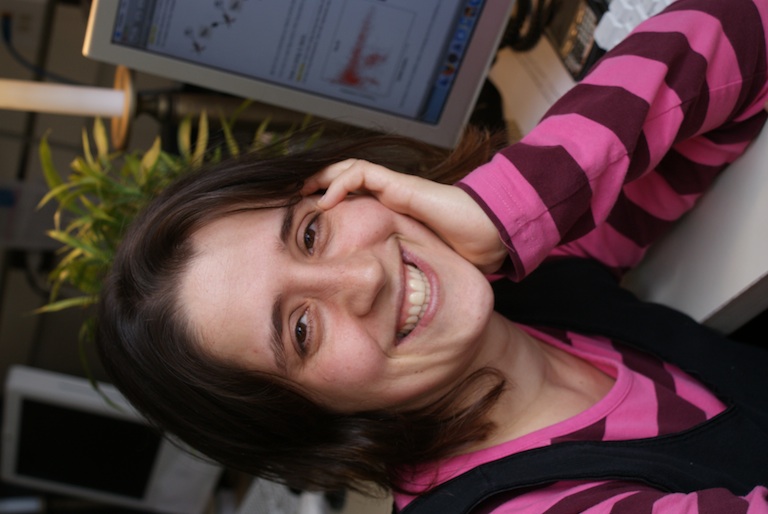
I am a postdoc at the Language Evolution group at Edinburgh University. I study the evolution of vocal communication systems, such as birdsong and human language. In particular, I am interested in the effects of individual learning, communication and social interactions on the evolution of human language and birdsong. I use experimental techniques which mimic cultural evolution in the laboratory, because they can provide us with insights into how communication systems could have evolved in the first place and how our brains restrict and guide their development and evolution. Visit my webpage for more information on my research. Email: olga.feher@ed.ac.uk.
Also featuring

Jon Carr, Yasamin Motamedi, Jennifer Culbertson, LEC & Daniela Singh, UCL
Jon, a PhD student, uses computational and experimental models to understand how category structures arise during cultural transmission to help us conceptualize the world around us.
Yasamin, who is also pursuing a PhD, studies how linguistic structure emerges in gestural communication, what gesture and sign language can tell us about language in general and how language adapts to the hands.
Jenny is a Chancellor’s Fellow at the LEC, and her research focuses on understanding how languages are shaped by learning and use. She is interested in how typological universals (differences in the frequency of linguistic patterns across the world’s languages) arise from properties of our cognitive system.
Daniela is an MSc student in Language Sciences at UCL. She studies the development of speech perception and production as well as language acquisition with a focus on statistical learning in both spoken and written language.
Our theme: Regularity in language
Our Museum Lates exhibition focuses on regularity by which we mean the absence of random variation. For instance, the concept of a “teabag” is represented by only one word and not 15, from which we can pick and choose at random. In our activity, we present 2 games to demonstrate that human brains work to eliminate random variation in language but not necessarily in other domains.
We study many aspects of regularity, for example my collaborators Kenny Smith, Niki Ritt and I recently showed that variation can disappear when people communicate with non-variable language users. In another study, we observed how people learn variable input from multiple speakers. If you would like to learn more about the science behind regularity, here’s a link to an ESRC project investigating this topic, led by Kenny Smith & Liz Wonnacott.
Our games
All of our games are based on an experimental method called iterated learning. Iterated learning is what happens in real life, when information from one person is passed to another who learns it and then transfers it to another individual. Language evolves this way, since we learn to speak from our parents who learnt it from their parents and back through time. To simulate this process in the laboratory, we teach people artificial languages, test them on how much they learnt, then take the language they produced and teach it to the next individual and so on. We also call these learning chains transmission chains, because information is transmitted between individuals.
Word game
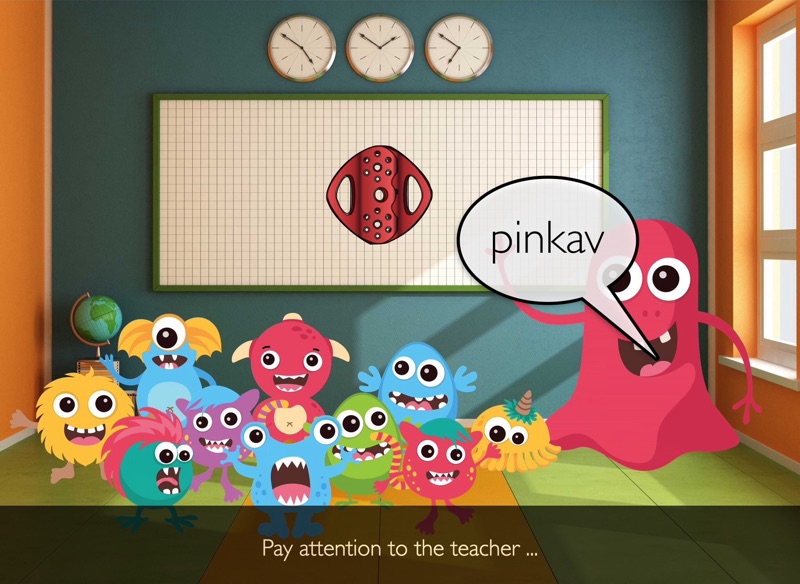
In our word game, you get to travel to outer space, but as luck would have it, you crash land on a foreign planet where you visit an alien schoolhouse in order to learn about spaceship parts which you need to fix your broken vessel. After you watch the teacher teach the pupils names of spaceship parts, you get to help the little aliens remember the names of these strange objects.
Veggie game

In this game, you are served with carrot and celery sticks, but if the idea of veggie cuisine doesn’t appeal to you, don’t be scared off. There’s no eating involved! The veggies come to life on screen in response to your touch and your task is to remember the right sequence.
Why alien languages and why veggies???
These games mimic actual experiments we run in the lab to study how people learn from variable input. One method we often use is teaching people artificial languages, which is a powerful method, because we can show that our linguistic expectations come into play even when we learn something very different from the languages we speak.
In the alien word game, every object has 2 names that vary randomly during the teacher’s presentation but in a given proportion, which means that out of 10 naming event, the teacher uses one of the words 6 times and the other 4 times, in random order. Most people in the lab learn the names very well and are able to reproduce the input proportion (in this case, 6:4) during testing, even without realizing it. However, when we take the output language of one person and teach it to the next (via iterated learning), people start using one word more than the other. This effect amplifies over several generations until variation drops out completely and you end up with only one word.
The veggie sequence game is to show that this only happens in a linguistic context. People are perfectly okay with variation, even random variation in other areas of life. For example when they have to learn and predict the proportion of heads to tails in a coin flipping task, people can do this very accurately and even when the output is passed from generation to generation, variation doesn’t disappear. If you are interested in this subject, you can read this conference paper by Vanessa Ferdinand.
Drawing Game

Our drawing transmission chain game is based on a paper by Monica Tamariz and Simon Kirby which showed that, even in the visual domain, when people are presented with abstract drawings that they are asked to reproduce, they introduce structure – across several generations, the drawings become less and less abstract and start to resemble things we have in our environment. However, this only happens when people have to recall the drawing from memory, which teaches us about how our brains retrieve visual information and how cultural transmission amplifies this process.
More on Language and Regularity
One thing that makes humans unique is their communication system, which is the most efficient, structured and flexible one in the animal kingdom. Human babies are born with the ability to learn any language, and once they have learned the rules of their language, they are able to express any thought, feeling or idea that they can think of. Languages differ in their specific rules, their grammar and their vocabulary; a pencil is “Bleistift” in German, “kalamu” in Swahili and “ceruza” in Hungarian, but these words express the same exact idea. What concepts are called is not important; as long as you know the names and the meanings, you can use the language. This is called the arbitrariness of language, word forms are unrelated to word meanings.
Despite the great differences between languages, there are certain properties all languages share. Our research is based on the idea that studying these properties can give us insights into how human brains work and how they constrain and guide the way languages evolved and how they change all the time.
One property of all human languages is their lack of random or unpredictable variation. One could imagine a language that has 28 words for “pencil” and a speaker would just have to pick one of these when needed. It would be difficult but certainly not impossible to remember these words and it might even be easier to recall them if you had more than one you could use for the same idea. However, this typically does not happen, one concept or thing usually has only one name. When synonyms do exist, they are not used completely interchangeably. So for example, a writing instrument can be a pen, a pencil, a crayon or a chalk, but they are made of different materials and have different properties.
As language learners we are biased in such a way that we tend to eliminate random variation when taught randomly varying, unpredictable languages. We study this phenomenon in the laboratory using artificial languages and iterated learning, mimicking the cultural evolution of languages. It often takes the brains of several generations of learners for some linguistic properties to appear, although as we’ve seen in the drawing game, this goes beyond language and is true to human cognition in general. In order to make sense of the world, we need to make it structured.