
Next week, Christine Caldwell will be visiting from Stirling. Christine has been a pioneer in using techniques from experimental psychology to study cultural evolution in the lab, and has recently been exploring the evolution of communication through cultural transmission.
“Adaptiveness and arbitrariness in human cultural evolution”, Christine Caldwell
Tuesday 26th July, 11-12.30, DSB 1.17
We’ll be going out for lunch with Christine after her talk. All welcome!
Cheers,
Simon
Chrissy Cuskley‘s research concerns the way in which cross-modal connections that we all share might have provided a starting point for the evolution of language by giving a non-arbitrary basis for the eventual evolution of symbols. Her experimental work looking at the connections between various senses and linguistic stimuli is featured on the cover of this week’s New Scientist magazine.
Have a look at the New Scientist article, and one of our papers (Simner, Cuskley & Kirby, 2010) for more information.
Demonstrating what a fast-moving field we work in, I’m once again having to change the schedule for our LEC talks. Sorry! Next Tuesday, Sean will tell us about his trip to Santa Fe:
“What can complex systems science tell us about language evolution?”
Sean Roberts
Abstract: I’ve spent a month at the Santa Fe Institute learning about complex systems. I’ll talk a bit about some of the things I learned about including: Cultural transmission and the singularity, how robustness relates to complexity in language, a non-linear model of cultural evolution and a chaotic cultural transmission model. Basically, this will be showing slides from my holiday at math camp. Bonus round: Why linguistic diversity correlates with number of traffic accidents.
Tuesday 11-12.30, DSB 1.17
For those of you who are doing your MSc at the moment or are just starting your PhD, this trip to Santa Fe is part of an initiative that runs regularly where PhD students get a fully funded trip to the Santa Fe Institute to learn about complexity science for a month. Sean is now the 5th LEC PhD student to attend.
Cheers,
Simon
This week, we’ll also have an LEC talk in our usual slot: 11-12.30 Tuesday in 1.17 DSB. Nic Fay will be giving the second part of a talk about his work covering new directions and some of the plans for work he will be developing here.
The evolution of human communication systems
I’ll present evidence showing that communication systems evolve to be easily learnt and produced. I’ll also look at how particular models (i.e., those perceived to be be skilful, successful, prestigious or similar to oneself) bias the evolution of human communication systems. To end I’ll talk about our planned experiments that will investigate the emergence of linguistic structure.
We’re having a special LEC talk tomorrow (Monday) at 2.00-3.30 in 1.17
DSB from Amy Perfors who is visiting for the day:
Language evolution is shaped by the structure of the world: An
iterated learning analysis
Human languages vary in many ways, but also show striking
cross-linguistic universals. Why do these universals exist? Recent
theoretical results demonstrate that Bayesian learners transmitting
language to each other through iterated learning will converge on a
distribution of languages that depends only on their prior biases
about language and the quantity of data transmitted at each point;
the structure of the world being communicated about plays no role
(Griffiths & Kalish, 2005, 2007). In this talk I will revisit these
findings and show that when certain assumptions about the
independence of languages and the world are abandoned, learners will
converge to languages that depend on the structure of the world as
well as their prior biases. These theoretical results are supported
with a series of experiments showing that when human learners acquire
language through iterated learning, the ultimate structure of those
languages is shaped by the structure of the meanings to be
communicated.
See you there!
Simon
Our next LEC talk will be from Barbora Skarabela:
“Systematicity in language evolution: Does the degree of input structure influence language learning?”
Tuesday 28th, 11-12.30, DSB 1.17
Cheers,
Simon
Professor Simon Kirby delivered his inaugural lecture entitled “The Language Organism: evolution, culture, and what it means to be human” on 22 March 2011. It is now available to watch online.
Abstract:
Our species can do something utterly unique in the natural world – a behaviour so transformative that it has reshaped the mechanisms of our own evolution. We are able to take a novel thought and cause another person to share that thought simply by recombining sounds we learned to make as children. Virtually all species communicate, but only humans have this trick called Language.
But where does this unique trait come from? How did it evolve? Why are we the only species that has it? The quest to answer these questions starts in the familiar world of biological evolution. Perhaps we have evolved an “organ” for language, just like other animals have their own specialised biological apparatus. However there is something very peculiar about language that makes such simple answers suspect. In recent years, work pioneered in Edinburgh has demonstrated that language itself is a new kind of evolutionary system — one we are only just beginning to understand.
In this talk, I will survey the progress made in making sense of this system and what it means for our understanding of language and of ourselves. Along the way we will see how we can study language evolution in the laboratory; what birds and foxes might tell us; and why culture might be changing the way we evolve.
Another accolade has come Thom’s way. He’s been named as one of two joint winners of the British Psychological Society’s Award for Outstanding Doctoral Research Contributions to Psychology.
More details: here.
Well done Thom!
Nic Fay is visiting us from UWA for 6 months, and will be giving a couple of LEC talks to introduce his work. The first of these is next week on Tuesday 14th from 11-12.30 in DSB 1.17. Details below:
Title: Evolution of human communication systems
In this talk I will present evidence (mostly experimental) in favour of an iconic origin for human communication systems. I will also argue that a social learning mechanism (interaction) drives language from it’s iconic roots to more symbolic forms.
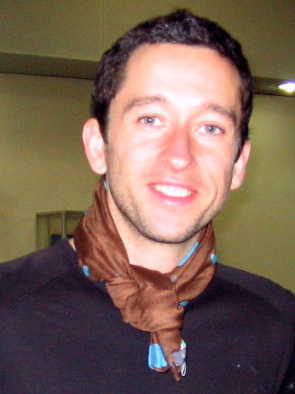 We’re delighted to be welcoming Nic Fay as a 6 month visitor to the LEC from Monday 6th June!
Nic is Associate Professor of Psychology at the University of Western Australia, and an expert in experimental approaches to the evolution of communication, and has a great influence on the work of the LEC. This is a great opportunity for us to learn first hand from someone who has carried out foundational work in the evolution of novel symbol systems.